Long screen time often causes eye strain, tension, and mental fatigue. Simple daily habits can relax focus, ease discomfort, and help your eyes feel clearer and more comfortable throughout the day.
🌿 When Screens Quietly Change How Your Eyes Feel
You rarely notice screen strain arriving.
It doesn’t come with a sharp warning or a sudden moment of discomfort.
It appears slowly—a tightness behind the eyes, a subtle heaviness around the forehead, a sense that your gaze isn’t quite gliding the way it did earlier.
Screens ask your eyes to work in a way they were never designed to—fixed distance, bright detail, relentless clarity. And your eyes, always patient, try to keep up until the tension gathers into something noticeable.
The world begins to look slightly flatter.
Your focus feels more like effort than a natural response.
Even blinking becomes less frequent, as if your body forgets that comfort requires moisture and movement.
Screen strain is not just a visual issue. It is a whole-body experience—the breath tightens, the neck becomes still, shoulders lift without permission, and the mind becomes narrowly concentrated in a way that feels draining rather than steady.
Reducing screen strain isn’t about doing more. It’s about remembering how your eyes are meant to exist—in rhythm, in softness, in motion.
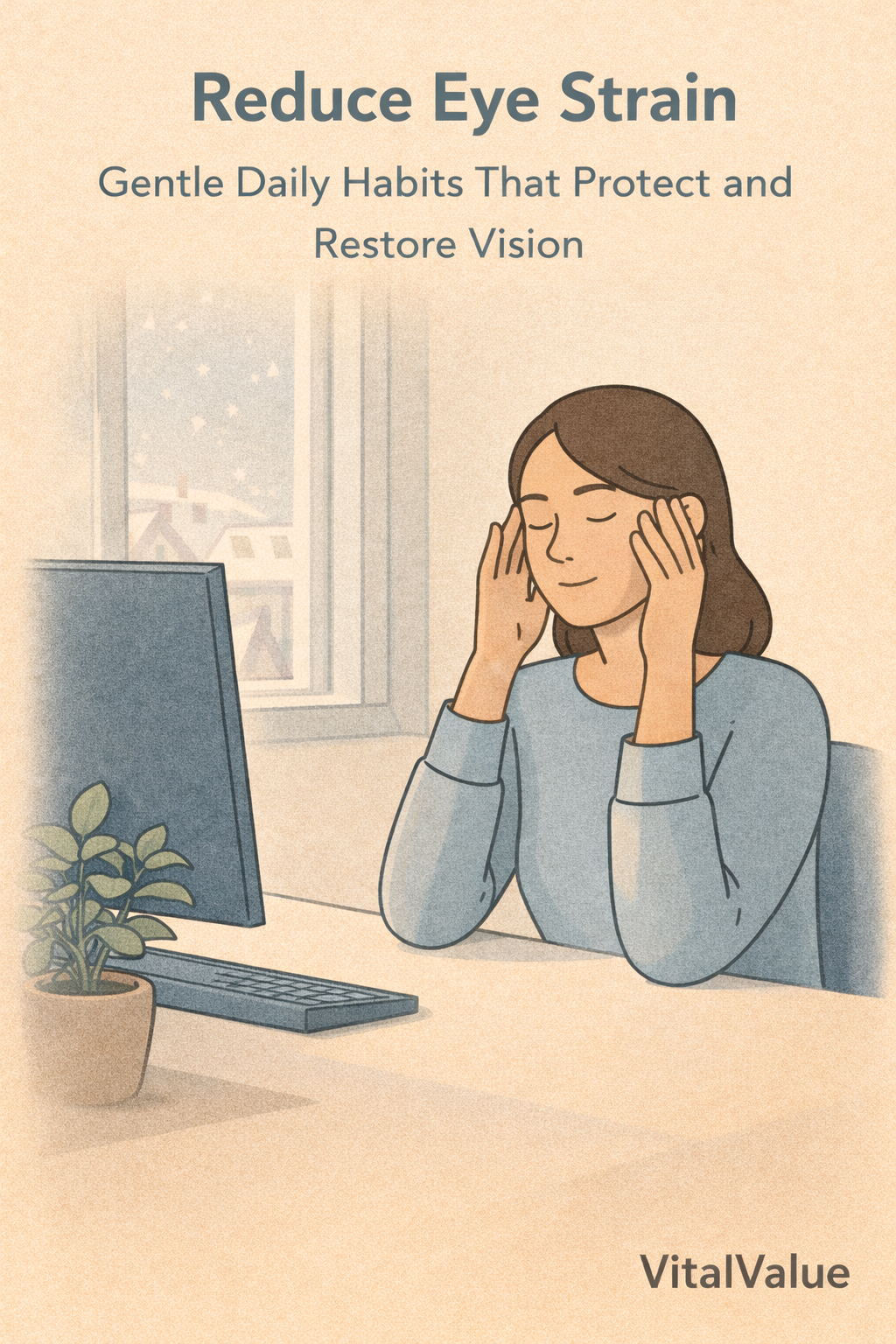
🌬️ How Screens Hold Your Eyes in One Place
Your eyes evolved for variety—distance, movement, shifting light, textures and shadows that continuously change.
But screens freeze that natural rhythm.
Your gaze becomes anchored, held in one singular plane for far longer than it should.
This stillness creates fatigue not from effort but from lack of variation.
Think of how your body feels after sitting in the same position for too long.
The discomfort doesn’t come from movement—it comes from the absence of it.
Your eyes behave the same way.
When the gaze is fixed, the tiny muscles around the eyes lose their natural flow.
Your vision becomes locked, and the strain spreads outward into the face, the head, the neck.
Reducing screen strain begins with returning movement to your eyes—not dramatic movement, but gentle, natural shifts that remind your gaze it is not meant to be held captive.
🌤️ Light, Brightness, and the Quiet Stress They Create
Screens glow with a type of brightness your eyes treat differently from natural light.
The glow is direct, constant, close.
Even when you think the brightness feels fine, your eyes continue adjusting, micro-second by micro-second, to keep details sharp.
This constant adjustment is one of the hidden causes of screen fatigue.
It isn’t painful, but it is draining.
Your eyes never get to rest in softer shadows or gradual transitions.
As the day goes on, this visual pressure builds, and your entire system begins responding—slower blinking, tighter breath, heavier thoughts.
Softening the brightness around you and giving your eyes a chance to experience more gentle light creates immediate relief—relief your body recognizes the moment your vision begins to relax.
🌾 The Role of Blinking: The Small Habit That Changes Everything
Blinking is the body’s way of refreshing vision.
It coats the eye with moisture, resets focus, and signals the nervous system to release its grip.
But during screen use, blinking becomes shallow.
Sometimes it nearly stops.
Your eyes dry before you even realize it.
Your vision sharpens too intensely, and the muscles around your eyes begin guarding the way a tired back might brace after a long day of sitting.
The simple act of blinking more naturally and more fully restores comfort—not by forcing moisture but by allowing your eyes to reclaim the rhythm that screens steal.
Blinking is one of the quietest forms of self-care. It’s small, but its effect is expansive.
🌙 The Connection Between Eye Strain and Mental Fatigue
Many people think screen strain affects only the eyes.
But the connection between vision and mental clarity is far deeper.
When your eyes strain, your brain strains with them.
Your mind becomes overloaded with visual detail, and attention becomes harder to maintain.
Simple tasks begin to feel heavier.
Thoughts lose their fluidity.
Your mood dips slightly without a clear reason.
These are not emotional issues—they are signs that your visual system needs rest.
A clearer gaze creates a clearer mind.
When your eyes relax, your thoughts follow.
When your eyes soften, your emotions settle.
When your eyes regain rhythm, your focus returns naturally.
Vision and mental wellness are inseparable.
🌧️ Returning Movement to the Eyes
To reduce strain, your eyes need movement—slow, unforced shifts that release the tension of staring straight ahead.
When your gaze drifts toward something distant, your eye muscles stretch in a way screens never allow.
This stretch can feel like a small breath of freedom.
Looking to the side, glancing at something across the room, resting your gaze briefly on a soft object—each of these movements loosens the stillness that screens reinforce.
Movement doesn’t need to be intentional.
It only needs to exist. Your eyes remember quickly how to move fluidly when given the chance.
🌬️ Environment Matters More Than People Realize
Screen strain isn’t created by screens alone.
It’s created by everything around them—the lighting, the air, the distance, the posture you fall into without noticing.
A dim room with a bright screen creates sharp contrast that exhausts the eyes.
Dry air turns the mildest strain into irritation.
A screen too close forces your gaze to tighten.
A screen too high or low pulls your neck into tension that eventually circles back into your eyes.
Creating a visually gentle environment is not about aesthetics.
It is about reducing the pressure that demands constant adaptation from your visual system.
When your surroundings soften, your eyes soften too.
🍃 Breathing as a Way to Relax Your Vision
It may seem unrelated, but the way you breathe changes the way your eyes feel.
Shallow breath narrows your focus.
It pushes your attention forward and tightens the muscles around your eyes and forehead.
Deeper, slower breath widens the field of vision.
It relaxes the micro-muscles that determine how sharply you focus.
This is why screen fatigue often comes with holding your breath without realizing it—your mind becomes so concentrated that your body forgets to breathe fully.
When breath becomes soft and steady, your eyes no longer grip the screen.
They observe instead of absorb.
🌤️ Evening Screen Use and the Weight It Leaves Behind
By evening, your eyes have already worked for hours.
Their capacity is lower, their patience thinner, their moisture reduced.
Evening screens amplify these effects.
Brightness feels sharper. Focus feels more rigid.
The pathway from alertness to rest becomes longer and more complicated.
Reducing evening screen strain is not about strict discipline.
It is about respecting your eyes when they have reached their limit.
When you soften evening screen use—lower brightness, increase distance, take more frequent pauses—your eyes recover faster and your sleep becomes deeper.
Evening screen habits shape the quality of your rest more than most people realize.
🌙 The Relief That Follows Visual Rest
There is a moment after stepping away from screens when your eyes begin to recalibrate.
Your gaze softens. Your forehead relaxes.
Your attention becomes diffuse rather than laser-sharp.
The world regains depth and texture.
Colors feel slightly warmer. Shapes feel more natural.
This is visual rest—the state your eyes long for throughout the day.
When you give your eyes even a small window of this rest, your entire system responds: your breath deepens, your posture loosens, your thoughts quiet, your mood shifts gently upward.
It’s a return to how your eyes are meant to function.
🌾 When Strain Finally Lets Go
After practicing gentle habits through the day, there comes a moment when screen strain truly dissolves.
You may feel it as a widening behind your eyes, as though space has opened up where pressure used to sit.
Or you might feel a slow sense of release along your temples and forehead.
Your eyes feel moist again.
Your gaze glides instead of grips.
The world becomes easier to look at.
This relief is subtle but unmistakable—a sign that vision is not just sight but comfort, rhythm, and movement.
Reducing screen strain is not about working harder to protect your eyes.
It’s about working more softly with yourself.
Your eyes do not need perfection. They need awareness.
They need breaks. They need gentleness. They need the chance to return to their natural flow.
And when they do, your entire day feels lighter.


